
Find Out Who Owns Haralson County Property
Start with a place. Turn it into a parcel, and let the parcel lead you to a name. Haralson County splits this work between two offices. The Board of Tax Assessors keeps the roll that lists the current owner of record. The Clerk of Superior Court holds the deed records that prove how ownership passed. A quick check of the latest conveyance confirms the tax roll has not gone stale.
- Normalize the street and ZIP, then open the Haralson qPublic landing page and follow its parcel-search link.
- Match the situs, acreage, parcel ID, and map context before taking the displayed owner of record.
- Search that name as grantee in GSCCCA Real Estate, then compare the newest deed's legal description and recording date.
- If the grantee is a company, check its name or registered agent through the Georgia eCorp Business Search.
A mailing address helps with legitimate property correspondence. But it says nothing about who occupies the site. If the live parcel application fails, call or visit the Tax Assessors. Do not rely on an unrelated commercial profile.
Keep a short evidence log as the property search advances. Note the search date, URL, address form, parcel number, roll name shown, result year, deed query, and newest matching instrument. A name search that returns nothing means little without its county, date span, and spelling. When a street query turns up several tracts, compare acreage and map context. Do this before carrying any owner name into the deed search. That discipline keeps a nearby parcel or parent tract from becoming a false answer.
Haralson County Assessor Names the Tax-Roll Owner
Haralson County's Board of Tax Assessors maintains real and personal property returns, transfer data, values, exemptions, and annual notices. It also handles the maps and the digest. Its qPublic search accepts a name, an address, a parcel ID, or an alternate ID. The parcel-card application may restrict some views. Owner fields should be checked in the live system. Treat any unfamiliar screen field as something to verify rather than assume. For questions, contact the assessor's office directly.
| Lookup key | Best use | Check before relying |
|---|---|---|
| Address | Starting with a known site | Street form, city, and parcel match |
| Name | Finding parcels under one roll name | Name order and entity spelling |
| Parcel ID | Returning to one tax-map unit | Current versus parent parcel |
| Alternate ID | Following a second local identifier | Which office assigned it |
Parcel IDs make stronger join keys than mailing addresses. One owner may receive mail somewhere else entirely. Rural tracts may lack a situs address altogether. The roll is also an assessment record, not a title opinion.
For a rural Haralson County tract, the road address may be incomplete. Start with parcel number and acreage instead. Preserve land district, land lot, stream, road, and adjoining-owner clues from the deed. For a platted parcel, copy the subdivision, unit, block, lot, and any referenced plat. These details test whether the roll result and the deed concern the same ground. USPS can standardize a postal form. But a ZIP result proves nothing about ownership, occupancy, or municipal limits.
Trace the Haralson County Owner to a Recorded Deed
The Clerk of Superior Court records deeds, security deeds, liens, cancellations, plats, FIFA, judgments, and UCC material at 4485 Georgia Highway 120 in Buchanan. GSCCCA offers search routes by party, instrument, county, date, book and page, and legal description, though accounts or fees may apply to images and some services. Once a deed turns up, compare the grantee, recording date, execution date, deed type, legal description, and prior deed reference. That comparison confirms the conveyance belongs to the parcel in question.
Owner of record is the name carried on the public roll. A grantee receives an interest under a deed. Title is the full legal bundle of interests, and no single name field settles it. A situs is where the property sits. The mailing address is simply where notices go.
A deed can prove one conveyance. But a later filing, probate order, lien, or competing interest still exists. For copy and indexing questions, contact the Haralson County Clerk of Superior Court at 770-646-2005.
GSCCCA describes online index coverage for every Georgia county. Coverage starts at least January 1, 1999, with historical data added over time. That is a coverage floor, not a promise that older Haralson County deed records or images are online. When the owner trail hits that boundary, give the clerk the last firm book and page. Include the recording date, party names, and legal description too. The clerk can then say whether the next link sits in a local index, an older deed book, a plat book, or another recorded series.
See the Haralson County Assessor Entry Point
The official qPublic county page is the verified doorway to the assessor property search.
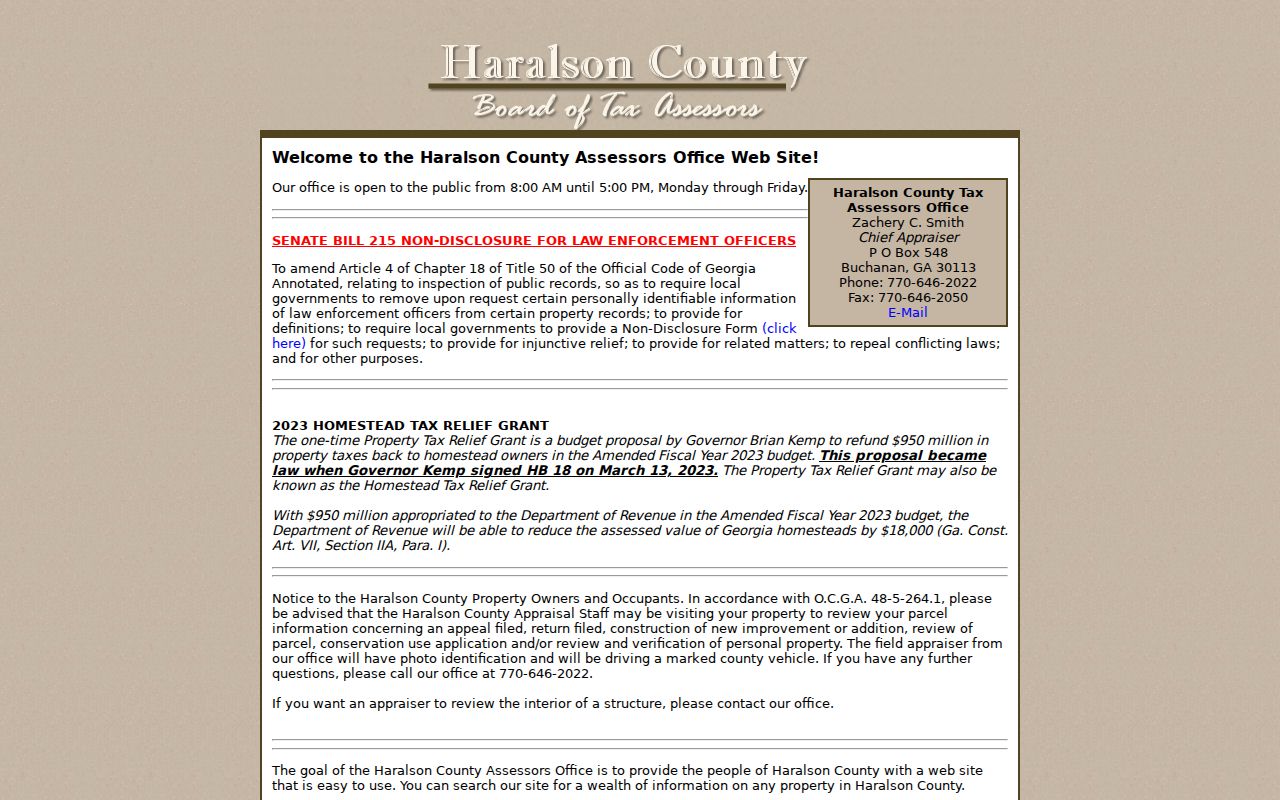
The official Board of Tax Assessors page confirms the county connection and the available search modes. The parcel-card interface itself limits direct views, so owner fields must be checked live in the assessor's application.
Identify Haralson County LLC, Trust, and Estate Owners
A roll may name an LLC, trust, estate, or fiduciary instead of a person. For a Georgia entity, search the exact business name, control number, registered agent, or officer at eCorp. Then return to the deed index with that exact spelling. The agent serves as a contact role and is not automatically the property owner.
When the recorded owner has died, the Haralson County Probate Court may hold a will, an administration, a year's-support matter, or fiduciary-sale authority. Link that order to the later recorded deed and the assessor transfer. A death record alone does not transfer land.
Note: Each office proves a different event. Keep parcel numbers, names, dates, and legal descriptions together as the trail moves between systems.
Haralson County Ownership Dates Can Fall Out of Step
Timing is where ownership questions trip people up. A deed has an execution date and a recording date, the assessor logs a transfer date, and the digest runs on its own annual cycle in Haralson County. Each answers a different question. A freshly recorded deed can sit in GSCCCA while the assessment roll still shows the prior owner of record. The reverse happens too. A roll entry can point you to a tract when the indexed name is misspelled. Trust the newest recorded conveyance over an older roll entry. Title questions may still need broader review.
The qPublic and GSCCCA platforms update their fields and account rules over time. Never assume the two pages refresh together. Check both dates fresh whenever ownership matters.
When the sources disagree, look for a reason. Test for a correction deed, a parcel split or merger, an estate conveyance, a tax-map change, or a city annexation. Don't just pick the name that looks newest. Ask the assessor which transfer and digest dates support its tax roll. Then ask the clerk which recording matches the same legal description. The answer to who owns the property should state the evidence date and flag any mismatch left unresolved.
Haralson County Owners Can Watch Future Filings
Georgia's Filing Activity Notification System, better known as FANS, sends alerts tied to indexing information. It looks forward only. A registrant can monitor property they own or are authorized to watch, which makes the service a practical safeguard for Haralson County owners. An alert is a prompt to inspect a filing. It is not proof that fraud occurred.
The official FANS page shows the statewide registration service behind this safeguard.
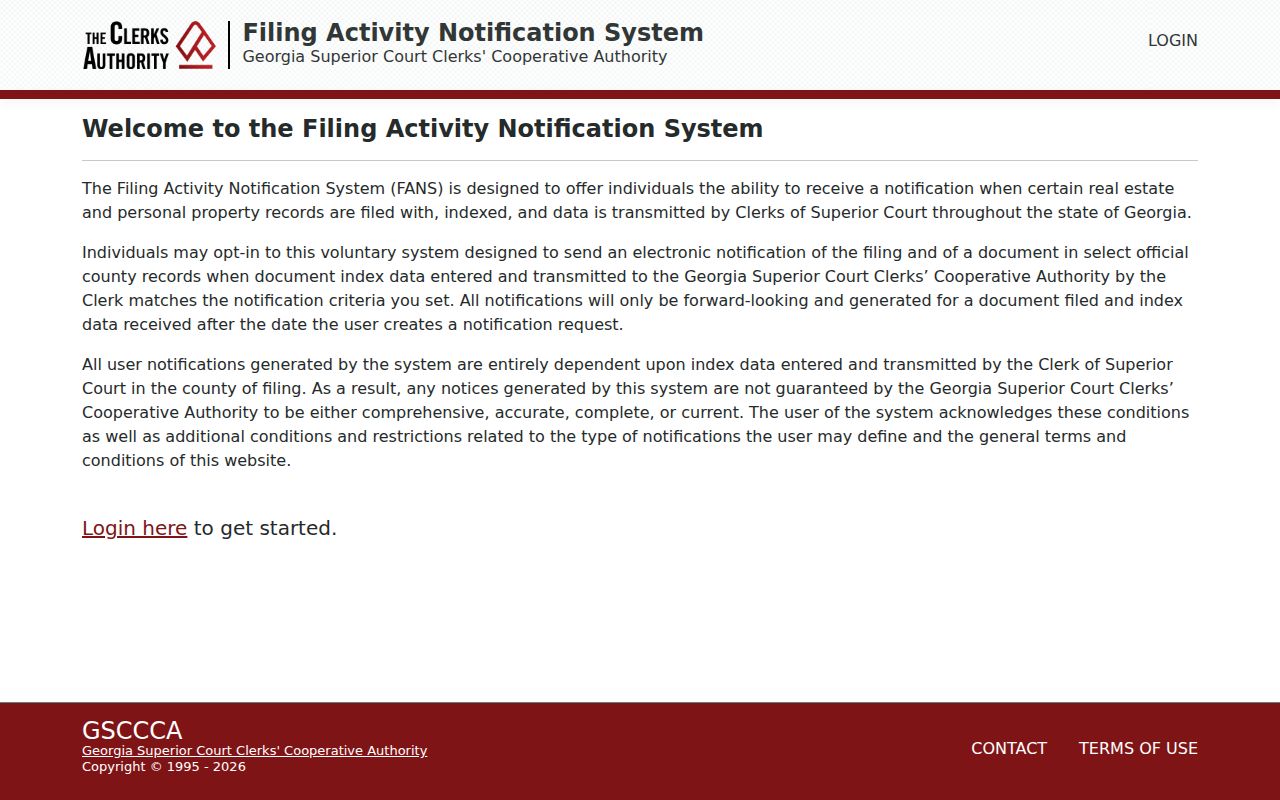
If a filing looks suspicious, confirm it with the Clerk and use the official complaint routes. Never confront a named party on the strength of an alert alone.
Where Haralson County Property Ownership Is Shown
No single screen answers every version of who owns this property. The sources here show different layers of Haralson County ownership, so read them together.
| Source | Owner Info It Gives | Access |
|---|---|---|
| Assessor roll | Published owner, mailing address, parcel and value context | qPublic landing page and assessor office |
| Recorded deed index | Grantee, instrument type, date, book/page and description route | GSCCCA account system or Clerk |
| Georgia business file | Entity status, agent and officer search clues | Free eCorp search |
| Parcel-map data | Location and parcel context tied to the tax roll | qPublic or county-assisted access |
The assessor and the parcel map carry the tax-roll name. The deed records the conveyance itself. Neither one proves who lives at an address. That line matters for accuracy and privacy alike. For the current roll in full detail, the Haralson County current owner guide walks through the lookup.
Limits on a Haralson County Property Owner Lookup
A public lookup certifies nothing about title. It cannot confirm occupancy, authority to sell, marital interests, or heir rights. Nor does it guarantee that every filing has been indexed. VoteSafe and other Georgia confidentiality rules may redact an address or personal data. An agency can also withhold records under a statutory exemption.
Use the record lawfully. An owner name from the roll is not a title search, and ownership may sit in an LLC or trust. Never use public data to stalk, harass, intimidate, or harm anyone.
When an agency file is not searchable, a narrow request to the custodian still works under Georgia's Open Records Act guidance. The agency generally must produce the records within three business days. Otherwise it must give a timetable, a cost estimate, and the exemption it is applying. It does not have to build a new report or run the search for you.
Name the existing item instead. Ask for a parcel card for a stated tax year. Request a transfer record. Ask for a deed indexed to named parties, or a location sheet tied to a parcel number. Request an electronic copy when practical, and ask for the legal basis behind any redaction. Georgia law protects specified personal and financial details. Assessor non-disclosure rules can also limit some address data. A lawful ownership search leans on the public parcel and title facts. It leaves protected personal data alone.